 Transgenerational Whispers
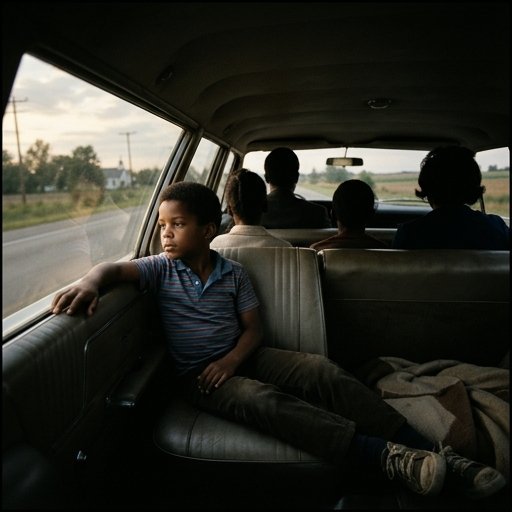
My father stopped the action. But he left the question alive.
Heading Home
It was the summer of 1964, and for the first time since our family had moved to Houston, I was headed back to Mississippi.
I was excited beyond measure.
I had heard so much about the place of my birth, Lumberton, Mississippi, a small town outside of Hattiesburg. To my ten-year-old imagination, it might as well have been another world.
Dad loaded up the station wagon, and off we went.
I was around five or six years old when we left Mississippi. By the summer of 1964, I had just turned ten, still bright-eyed and bushy-tailed, eager to see the place everyone talked about but that I barely remembered.
The long drive itself was unremarkable except for one challenge: finding a decent radio station.
What I remember most began after we arrived.
The Darkest Night I’d Ever Seen

The first thing that struck me was the night sky.
I had never seen darkness like that before.
There were no streetlights.
No glow from nearby neighborhoods.
No distant traffic.
After sunset, the world simply disappeared into blackness.
It was beautiful.
It was terrifying.
And it was unlike anything I had ever experienced in Houston.
Unfortunately, things only got worse after dinner.
My aunts and uncles seemed to believe that the best way to entertain themselves was by telling ghost stories.
One after another.
Hauntings.
Spirits.
People hearing things out in the fields after dark.
As the evening wore on, my younger brother and I became increasingly convinced that we would never survive the night.
That conviction deepened when we discovered our bed faced a large open field.
The field seemed harmless during daylight. At midnight it became the staging ground for every ghost story we had just heard.
My brother bailed on me.
I stayed.
Mostly because pride can make a ten-year-old do foolish things.
I lay awake staring into darkness, listening to unfamiliar sounds and imagining things that probably weren’t there.
I’m fairly certain I got less than thirty minutes of sleep.
The next morning, I was already awake when my grandmother began preparing breakfast.
She looked at me.
I looked at her.
Neither of us said a word.
Yet somehow she knew.
And somehow I knew she knew.
Years later, I would come to understand that some communication never requires words.
The Front Porch
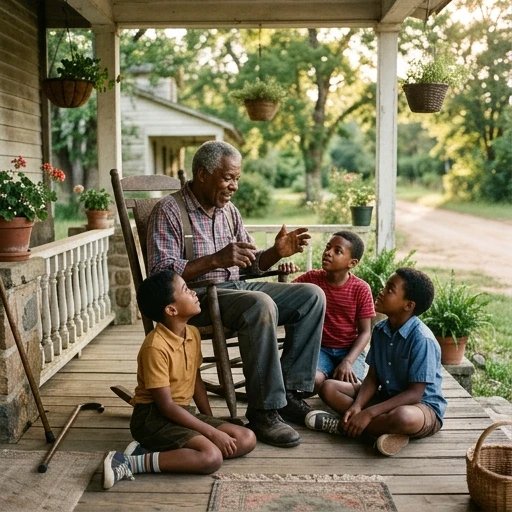
After breakfast, I joined my grandfather on the front porch.
That is when my cousins decided to share a piece of family history I had never heard before.
One of them informed me that my grandfather wasn’t really my grandfather. My mother, they explained, was from my grandmother’s previous marriage.
At ten years old, the statement landed like a hammer.
I remember feeling confused.
Embarrassed.
Maybe even a little lost.
My grandfather must have seen it immediately.
Without hesitation he looked at me and said:
“I am all y’alls grandfather.”
Just like that.
No lecture.
No explanation.
No family tree.
The matter was settled.
For a ten-year-old boy, it was exactly what needed to be said.
And exactly enough.
The rest of the visit unfolded like scenes from another world.
My older sisters headed off to pick cotton for spending money.
My grandfather loaded my brother, a cousin, and me into a horse-drawn wagon and took us to gather water from a nearby creek.
I had never seen water so clear in my life.
Fish swam beneath the wagon wheels.
The water tasted better than anything I had ever drunk.
Then came outdoor baths on the porch.
No way was I getting in that tub on the porch after my sisters and cousins. Unfortunately, that wasn’t my decision to make.
Then came catching hogs. Or more accurately, trying to catch hogs.
My cousins weren’t much help. Eventually my grandfather handled the matter himself. I stood fascinated as he built a massive fire, butchered the hog, and prepared a feast for the family.
As for the chickens, I wasn’t about to catch a chicken and wring its neck. My cousins turned out to be much better suited for that assignment.
My Father’s Side
Later we visited my father’s side of the family.
One stop was a woman who, according to my father, had helped raise me when I was very young.
To this day I do not know the entire story.
But I remember that she mattered.
And I remember that she mattered to him.
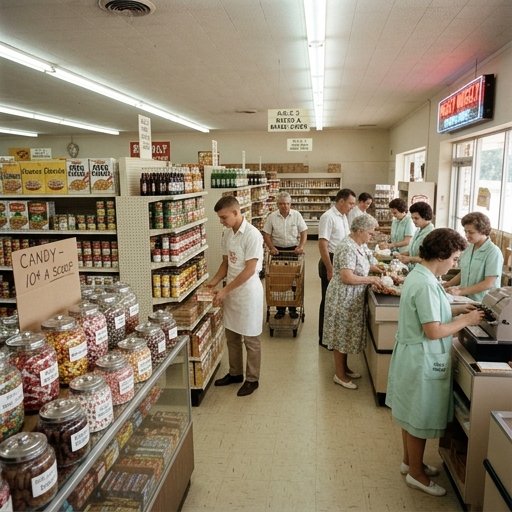
We also stopped at a grocery store where my uncle worked.
It was the largest store I had ever seen.
What I remember most wasn’t the store itself.
It was the feeling.
The owner watched us constantly.
Other customers did too.
At ten years old I didn’t know exactly what I was seeing.
I only knew I didn’t like the feeling.
It made me very uneasy.
Today, I understand much better.
But then I looked at my father and my uncle.
I watched the way they carried themselves.
The calm.
The confidence.
The dignity.
The certainty.
Whatever they knew, it settled me immediately.
Standing there between those two men, I felt safer than any ten-year-old had a right to feel.
Years later I would realize they understood things about the world that they had not yet shared with me.
Downtown Hattiesburg
The final day arrived.
The family regrouped and headed into downtown Hattiesburg.
It was a Saturday morning. Traffic moved slowly. As we approached an intersection, I saw the reason why.
Men dressed in white robes and white hoods stood along both sides of the street handing out pamphlets.
I noticed a change in my parents.
Not panic.
Not fear.
But tension.
The kind of tension children notice even when they don’t understand it.
What could one expect from a ten-year-old?
My curiosity took over.
I rolled down the station wagon window.
Stuck my arm outside.
And reached for one of the pamphlets.
The hooded man froze. For a brief moment he simply stared.
Then my father saw what was happening.
His voice cut through the air.
Sharp.
Immediate.
Unlike anything I had heard before.
“James Earl, put that window up. Now.”
I did.
Immediately.
The Whisper of Silence
The ride back to Houston was quiet.
Remarkably quiet.
No one discussed what happened.
No one explained why.
No one scolded me.
No one shamed me.
No one revisited it later.
In fact, once we got home, the entire incident simply disappeared into silence.
For years I assumed the lesson had something to do with race.
Today I’m not so sure.
Looking back through the lens of Transgenerational Whispers, I think the lesson may have been something else entirely.
I sometimes wonder if my father understood something that I did not.
Curiosity can be fragile.
Once extinguished, it does not always return.
My father understood the reality of Mississippi in 1964. He understood dangers that I was too young to comprehend. Yet he chose not to place that burden on a curious ten-year-old boy.
He stopped the action.
But he left the question alive.
And perhaps that made all the difference.
If I had been publicly shamed, harshly punished, or made to carry the weight of adult fears that day, some part of my curiosity might have disappeared.
Instead, the question remained.
The need to understand remained.
The desire to keep searching remained.
That curiosity followed me into technology.
Into therapy.
Into Signal & Soul.
Into Clinical Trial Equity.
Into Transgenerational Whispers.
And into nearly every question I continue to ask today.
Sometimes the loudest inheritance is not what is said.
Sometimes it is the silence that follows.
And every now and then, a ten-year-old boy reaching out a station wagon window spends the rest of his life trying to understand why.
Author’s Reflection
This story is dedicated to the questions that survive long after the moment itself has passed.
Some answers arrive quickly.
Others take a lifetime.
What question from your childhood is still asking to be understood?
James E. Gray, Sr.
Founder, Transgenerational Whispers